
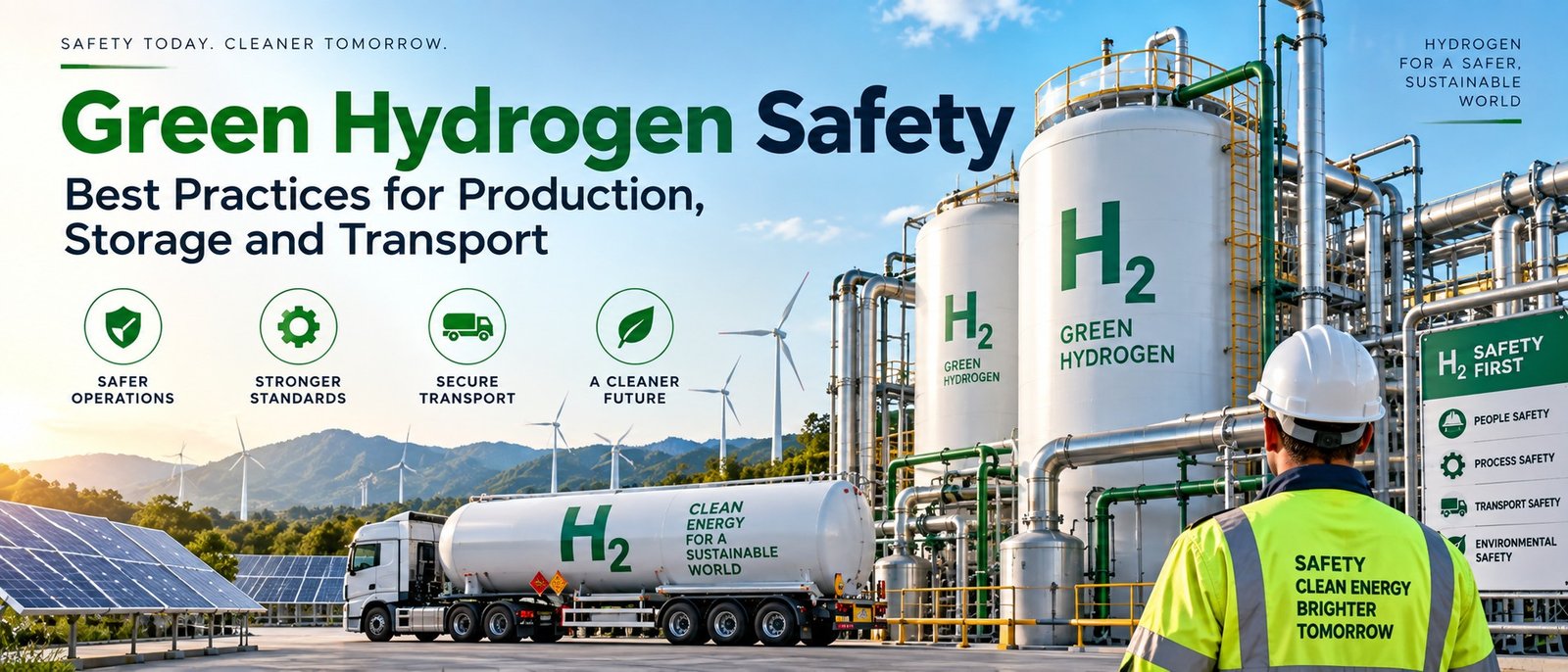
Green hydrogen safety is essential for the reliable production, storage and transportation of hydrogen. Although hydrogen has been used safely in industrial applications for decades, its flammability, low ignition energy, leak potential and material compatibility requirements demand careful engineering and operational controls.
As green hydrogen projects expand from pilot plants to commercial facilities, safety must be addressed throughout the project lifecycle. This includes electrolyser design, gas purification, compression, storage, pipelines, loading and unloading, maintenance and emergency response.
Green hydrogen safety relies on a combination of hazard identification, suitable materials, leak detection, ventilation, pressure protection, electrical safety, process controls, trained personnel and compliance with applicable codes and standards.
This guide explains the principal hydrogen hazards, technical safety measures, international standards and practical considerations for developers, operators and businesses planning hydrogen projects.
1. Understanding Hydrogen Safety and Its Physical Properties
Hydrogen has physical and chemical properties that influence how it must be produced, stored and handled. Understanding these properties is the starting point for effective safety engineering.
According to the U.S. Department of Energy (DOE), hydrogen is non-toxic, highly flammable, colourless and odourless. Its low density allows it to disperse rapidly in many open-air conditions, but releases in enclosed or poorly ventilated spaces can create hazardous concentrations.
|
Property |
Typical characteristic |
Safety implication |
|---|---|---|
|
Chemical formula |
H₂ |
Hydrogen is a diatomic gas under normal conditions |
|
Flammability in air |
Approximately 4% to 75% by volume |
A wide flammable range requires effective leak prevention and ignition control |
|
Minimum ignition energy |
Very low, approximately 0.02 mJ under commonly cited test conditions |
Small ignition sources can ignite certain hydrogen-air mixtures |
|
Relative density |
Approximately 0.07 compared with air |
Hydrogen tends to rise and disperse in open spaces |
|
Odour and colour |
Odourless and colourless |
Leaks cannot be reliably detected by human senses |
|
Flame visibility |
Often difficult to see in daylight |
Dedicated flame detection may be required |
|
Material interaction |
Can cause hydrogen-related degradation in susceptible materials |
Material selection and qualification are essential |
|
Cryogenic temperature |
Liquid hydrogen boils at approximately −253°C at atmospheric pressure |
Cryogenic burns, thermal stress and boil-off management are important |
These are representative physical properties, not design values. Actual engineering calculations must use appropriate property data and operating conditions.
What are the main hydrogen safety hazards?
The main hazards associated with hydrogen systems include:
-
Fire and explosion: Leaked hydrogen can form flammable mixtures with air.
-
Pressure-related incidents: Compressed hydrogen systems store significant energy and require suitable pressure protection.
-
Material degradation: Some metals and components can suffer hydrogen-assisted cracking or other forms of degradation.
-
Asphyxiation: Hydrogen can displace oxygen in confined spaces, even though it is non-toxic.
-
Cryogenic injury: Liquid hydrogen can cause severe cold burns and damage materials through extreme cooling.
-
Difficult flame detection: Hydrogen flames can be difficult to see under normal lighting.
These hazards are manageable through appropriate engineering, maintenance, operating procedures and emergency preparedness. The DOE provides further guidance in its Safe Use of Hydrogen resource.
2. Hydrogen Production Safety: Electrolysers and Plant Operations
Green hydrogen is commonly produced through water electrolysis, in which electricity separates water into hydrogen and oxygen. Industrial systems may use alkaline, proton exchange membrane (PEM), anion exchange membrane (AEM) or solid oxide electrolysis technologies.
Each technology has distinct operating conditions and equipment requirements. Safety measures must therefore reflect the selected electrolyser design and its balance-of-plant systems.
Key safety measures for hydrogen production
1. Electrolyser design and protection
Electrolysers should be selected, designed, installed and operated according to their applicable safety requirements, manufacturer specifications and relevant codes.
The design assessment should consider:
-
Hydrogen and oxygen separation
-
Pressure and temperature limits
-
Gas purity and cross-contamination
-
Electrical isolation and protection
-
Cooling and water treatment
-
Safe startup, shutdown and maintenance
-
Instrumentation and control system reliability
The current international product safety standard is ISO 22734-1:2025: Hydrogen generators using water electrolysis, Part 1: Safety. It specifies safety requirements for hydrogen generation appliances and systems using electrochemical water electrolysis.
2. Hydrogen and oxygen purity monitoring
Electrolyser systems must control the quality and separation of hydrogen and oxygen streams. Membrane performance, differential pressure, operating conditions and degradation can affect gas purity.
Depending on the equipment design and hazard assessment, appropriate instrumentation may include:
-
Hydrogen-in-oxygen analysis
-
Oxygen-in-hydrogen analysis
-
Pressure and differential-pressure monitoring
-
Temperature monitoring
-
Gas flow measurement
-
Automatic protective interlocks
Alarm and shutdown thresholds must be based on the manufacturer’s requirements, applicable standards and project-specific hazard analysis. There is no single trip setting suitable for every electrolyser.
3. Ventilation and hazardous area classification
Hydrogen may accumulate at high points within buildings or equipment enclosures where ventilation is inadequate.
Engineering assessments should consider:
-
Potential leak locations
-
Enclosure geometry
-
Ventilation effectiveness
-
Roof spaces and structural pockets
-
Detector placement
-
Electrical equipment classification
-
Safe discharge locations
Hazardous area classification should be performed by competent professionals under the applicable local regulations and recognised standards. Do not automatically assign a fixed Zone 1 or Zone 2 classification to every electrolyser room or compressor enclosure.
Where required, electrical equipment must be suitable for the classified location and the applicable protection method.
4. Inert gas purging
Inert gas purging, commonly using nitrogen, may be required during startup, shutdown, maintenance and specific emergency procedures.
The purging sequence must be designed to prevent hazardous hydrogen-oxygen mixtures and unintended gas releases. The procedure should specify the permitted sequence, pressure conditions, verification requirements, discharge arrangements and controls for oxygen-deficient atmospheres.
5. Emergency shutdown systems
Emergency shutdown systems should be designed around the process hazard analysis and the required safety functions.
Potential protective actions include:
-
Isolating hydrogen feed and discharge
-
Stopping electrolyser operation
-
Isolating affected equipment
-
Activating alarms
-
Initiating suitable ventilation or other engineered responses
-
Safely managing residual gas and pressure
Shutdown logic, instrument reliability, independence, testing and reset procedures should be defined in the safety requirements for the facility.
3. Hydrogen Storage Safety: Compressed Gas and Liquid Hydrogen
Hydrogen storage introduces additional hazards because of its low volumetric energy density, high-pressure requirements or cryogenic operating conditions.
The appropriate storage system depends on production capacity, hydrogen demand, delivery method, site constraints and the required storage duration.
The U.S. Department of Energy’s hydrogen storage guidance describes physical storage as compressed gas or cryogenic liquid, as well as approaches involving adsorption and absorption in materials.
A. Compressed hydrogen storage
Compressed gaseous hydrogen is commonly stored in purpose-designed pressure vessels or cylinders.
Typical considerations include:
-
Design pressure and operating temperature
-
Pressure vessel certification
-
Material compatibility
-
Pressure relief
-
Overpressure protection
-
Leak detection
-
Inspection and maintenance
-
Impact protection
-
Safe separation and access
Storage systems may use different cylinder constructions, including all-metal and composite designs. The suitability of each depends on its approved application and design specification.
Pressure relief devices must be appropriately selected, sized, installed and maintained. Their discharge arrangements must prevent hazardous exposure, ignition or accumulation. Relief system design should account for credible overpressure scenarios, including applicable external fire cases.
Storage layout and separation distances must be determined under the applicable code, installation design and site risk assessment, rather than applying a single generic distance to all projects.
B. Liquid hydrogen storage
Liquid hydrogen is stored at cryogenic temperatures, near −253°C at atmospheric pressure.
Its storage systems require specialised insulation, pressure management and handling procedures.
Important safety considerations include:
-
Cryogenic vessel design and certification
-
Thermal insulation and vacuum integrity
-
Boil-off gas management
-
Pressure relief and safe vent discharge
-
Cryogenic-compatible materials
-
Cold burns and personnel protection
-
Oxygen displacement and ventilation
-
Protection against liquid hydrogen accumulation
Heat ingress can cause liquid hydrogen to vaporise, increasing vessel pressure. Storage designs must therefore provide appropriate pressure control, relief protection and a safe means of managing boil-off gas.
Personnel should be trained in cryogenic handling and use appropriate protective equipment. Liquid hydrogen releases also require careful assessment of cold gas dispersion, potential oxygen condensation and nearby combustible materials.
C. Hydrogen carriers and alternative storage
Hydrogen may also be transported or stored in chemical carriers such as ammonia or liquid organic hydrogen carriers. These systems introduce additional hazards related to carrier toxicity, flammability, chemical handling, conversion processes and release scenarios.
A carrier-based hydrogen project must assess both the carrier’s own hazards and the risks of hydrogen release during conversion or processing.
4. Hydrogen Transportation and Distribution Safety
Hydrogen can be transported through dedicated pipelines, tube trailers, liquid hydrogen tankers and carrier-based logistics systems.
Each transportation method presents different engineering and operational requirements.
The DOE’s Hydrogen Delivery programme identifies compression, storage, pipelines, liquefaction and delivery infrastructure as important areas of hydrogen system development.
A. Dedicated hydrogen pipelines
Dedicated pipelines require careful design, material qualification, fabrication controls, inspection and maintenance.
The applicable requirements depend on pressure, temperature, hydrogen purity, pipeline location, materials and jurisdiction.
For hydrogen piping and pipeline systems, consult ASME B31.12-2023: Hydrogen Piping and Pipelines . The code addresses hydrogen piping and pipeline systems and provides requirements for their engineering and construction.
Key engineering considerations include:
-
Material suitability and hydrogen compatibility
-
Pressure and temperature design
-
Welding procedures and qualification
-
Inspection and non-destructive examination
-
Leak testing and commissioning
-
Pressure relief and isolation
-
Corrosion and integrity management
-
Emergency response and operating procedures
The pipeline design should also consider fatigue, pressure cycling, fracture mechanics, potential hydrogen-assisted cracking and the characteristics of the transported gas.
B. Hydrogen blending in natural gas networks
Blending hydrogen into existing natural gas networks is not automatically safe at a universal concentration.
Compatibility depends on pipeline materials, operating pressure, compressors, valves, seals, meters, connected equipment and the needs of end users.
A blending project requires a technical assessment of the complete network, including potential impacts on gas quality, appliances, equipment performance, material integrity and applicable regulatory requirements.
Do not use a generic 15% or 20% blending threshold as a universal safety limit. Permissible concentrations must be established for the specific network and jurisdiction.
C. Tube trailers and road transport
Compressed hydrogen tube trailers and liquid hydrogen transport vehicles require suitable pressure containment, approved equipment, secure connections and trained operators.
Safety procedures should cover:
-
Vehicle inspection and maintenance
-
Approved cylinder or tank systems
-
Loading and unloading operations
-
Secure connections and transfer equipment
-
Vehicle positioning and access control
-
Emergency isolation
-
Static electricity and ignition-source control
-
Safe separation from the public and other operations
-
Incident response and communication
Loading and unloading areas should be designed with suitable ventilation, access controls, equipment protection and emergency arrangements. Transfer procedures should specify connection checks, leak testing, operating limits and safe disconnection.
5. Hydrogen Leak Detection, Fire Protection and Ventilation
Hydrogen is colourless and odourless, so smell and visual inspection are not reliable methods of leak detection.
A comprehensive detection and protection strategy should be based on the facility’s hazard assessment and credible release scenarios.
Hydrogen leak detection
Depending on the installation, gas detection systems may use technologies such as catalytic, thermal conductivity, electrochemical or other suitable hydrogen sensing methods.
Detector selection should account for:
-
Expected hydrogen concentration
-
Environmental conditions
-
Response time
-
Cross-sensitivity
-
Calibration and maintenance requirements
-
Installation location
-
System reliability
-
Required alarm and shutdown functions
Detector placement should be determined by release scenarios, ventilation patterns, enclosure geometry and the relevant design guidance. Hydrogen’s buoyancy is important, but simply installing detectors at roof level is not sufficient for every configuration.
Hydrogen flame detection
Hydrogen flames can be difficult to see, particularly in daylight. Suitable flame detection may be required where the hazard assessment identifies a credible fire scenario.
Detector technology, coverage, response time, environmental performance and integration with alarm systems should be assessed for the particular facility.
Ventilation and ignition control
Ventilation should prevent hazardous gas accumulation under credible release conditions. Both natural and mechanical ventilation may be considered, subject to the design and applicable requirements.
Ignition control measures may include:
-
Suitable electrical equipment
-
Control of hot surfaces and sparks
-
Bonding and grounding where appropriate
-
Control of maintenance activities
-
Permit-to-work systems
-
Appropriate equipment selection
-
Safe discharge and vent locations
Ventilation and detection should be treated as complementary safeguards, not substitutes for leak prevention, isolation and sound process design.
6. Hydrogen Safety Standards and Regulations
Hydrogen safety standards provide technical frameworks for designing, constructing, testing and operating hydrogen systems. Their legal applicability depends on the jurisdiction, adopted editions, project type and regulatory requirements.
The following are relevant references for hydrogen projects.
|
Standard or code |
Main application |
Official reference |
|---|---|---|
|
ISO 22734-1:2025 |
Safety of hydrogen generators using water electrolysis |
|
|
ISO/TS 15916:2026 |
Basic safety considerations for hydrogen systems |
|
|
ASME B31.12-2023 |
Hydrogen piping and pipelines |
|
|
NFPA 2:2023 |
Hydrogen Technologies Code |
|
|
IEC 60079 series |
Explosive atmospheres and equipment protection |
|
|
Applicable local regulations |
Permits, fire safety, occupational health, environmental and facility requirements |
Relevant national or regional authority |
Important standards update: ISO 22734:2019 has been superseded by ISO 22734-1:2025. Similarly, ISO/TR 15916:2015 has been withdrawn and replaced by ISO/TS 15916:2026. The current ISO catalogue confirms these editions and their publication status.
No single international standard replaces local regulatory approval or project-specific engineering.
7. Hydrogen Risk Assessment and Emergency Response
A hydrogen facility should have a documented safety management process covering design, construction, commissioning, operation, maintenance and decommissioning.
Risk assessment should identify hazards, evaluate credible scenarios and establish safeguards appropriate to the facility.
Common risk assessment methods
-
HAZID: Hazard identification during early project development.
-
HAZOP: Structured review of process deviations and potential consequences.
-
What-if analysis: Examination of potential abnormal operating scenarios.
-
FMEA: Analysis of failure modes and their effects.
-
LOPA: Assessment of independent protection layers for selected hazardous scenarios.
-
Quantitative risk assessment: Numerical evaluation of risk where required by the project or regulatory framework.
The methods used should reflect project complexity, applicable requirements and the decisions that need to be supported.
Emergency response planning
Emergency plans should define responsibilities, alarm arrangements, communication, isolation strategies, evacuation procedures and coordination with local emergency services.
They should address scenarios such as:
-
Hydrogen leaks
-
Fire and explosion
-
Pressure vessel or piping failure
-
Electrolyser malfunction
-
Loss of ventilation
-
Cryogenic liquid release
-
Power failure
-
Abnormal process conditions
Emergency response procedures must be site-specific and coordinated with qualified responders. Personnel should receive appropriate training and participate in relevant drills.
The DOE’s Hydrogen Program safety resources and H2Tools hydrogen safety resource provide further information on hydrogen safety, training, incidents and best practices.
8. Practical Hydrogen Safety Checklist for Project Developers
Before construction or commissioning, project developers and operators should verify that the safety management system addresses the following areas.
|
Project stage |
Essential safety considerations |
|---|---|
|
Feasibility |
Site hazards, hydrogen demand, utilities, access, preliminary risk assessment |
|
Engineering |
Process design, equipment specifications, material compatibility, ventilation, hazardous area classification |
|
Procurement |
Equipment certification, manufacturer documentation, inspection and testing requirements |
|
Construction |
Quality assurance, welding qualification, inspection, pressure testing and construction safety |
|
Commissioning |
Purging, leak testing, functional testing, control-system validation and operating procedures |
|
Operation |
Monitoring, preventive maintenance, inspection, training and management of change |
|
Transportation |
Approved containment, transfer procedures, vehicle safety and emergency arrangements |
|
Decommissioning |
Safe isolation, depressurisation, purging, waste handling and verified gas-free conditions |
A formal safety review should confirm that the required safeguards are installed, tested, documented and maintained before the facility enters operation.
9. The Future of Green Hydrogen Safety
As hydrogen production and distribution infrastructure expands, safety practices will need to evolve alongside new technologies and project configurations.
Important development areas include:
-
More reliable hydrogen sensors
-
Improved material compatibility data
-
Advanced process monitoring
-
Digital inspection and asset integrity systems
-
Better ventilation modelling
-
Improved risk assessment methods
-
Standardised workforce training
-
More comprehensive incident reporting
-
Updated technical standards
Digital monitoring and predictive maintenance may help operators identify equipment degradation and abnormal conditions earlier. However, these tools should supplement, not replace, validated safety systems, physical inspections and established operating procedures.
International collaboration through organisations such as ISO, IEC, ASME and NFPA will continue to support the development and application of hydrogen safety standards.
The new ISO/TS 15916:2026 provides updated general safety guidance for gaseous, liquid and other hydrogen storage forms, while application-specific standards address more detailed requirements.
For project developers, the central priority remains the integration of safety into the complete project lifecycle, from early site selection and design to long-term operation and decommissioning.
Frequently Asked Questions
1. Is green hydrogen dangerous?
Green hydrogen is not inherently unsafe, but it is highly flammable and requires appropriate handling. Its low ignition energy, wide flammability range and potential for leakage require effective engineering controls, ventilation, detection, equipment selection and trained personnel.
2. What are the main safety risks in green hydrogen production?
The main risks include hydrogen leakage, fire, explosion, pressure-related incidents, hydrogen-oxygen cross-contamination, electrical hazards and equipment failure. The actual risk profile depends on the electrolyser technology, plant layout, operating conditions and safeguards.
3. How is hydrogen leakage detected?
Hydrogen leakage can be detected using suitably selected gas sensors, supported by monitoring systems, alarms and protective controls. Detector type and placement should be based on credible release scenarios, ventilation, enclosure design, environmental conditions and the relevant engineering standards.
4. What safety standards apply to green hydrogen production?
Relevant standards include ISO 22734-1:2025 for water electrolysis hydrogen generators, ISO/TS 15916:2026 for general hydrogen system safety, and applicable codes such as NFPA 2 and ASME B31.12. The precise requirements depend on the jurisdiction, facility and system design.
5. How can hydrogen embrittlement be prevented?
Hydrogen-related material degradation is managed through suitable material selection, design, fabrication, operating limits, inspection and maintenance. Material suitability must be assessed for the specific hydrogen environment, pressure, temperature, stress conditions and applicable engineering code. No single alloy is universally suitable for every hydrogen system.
6. Is liquid hydrogen more difficult to store than compressed hydrogen?
Liquid hydrogen requires cryogenic storage near −253°C at atmospheric pressure, specialised insulation and boil-off management. Compressed hydrogen requires pressure-rated storage and associated pressure protection. Both have distinct engineering challenges, and the appropriate option depends on the project’s scale, delivery method, site and operating requirements.
7. What should businesses do before starting a green hydrogen project?
Businesses should assess hydrogen demand, electricity and water availability, site suitability, technology selection, material compatibility, storage and transport needs, applicable standards and project economics. A formal hazard assessment and regulatory review should be included in project planning, with qualified engineering professionals responsible for safety-critical decisions.
Conclusion
Green hydrogen safety is fundamental to developing reliable hydrogen production, storage and transportation infrastructure. Although hydrogen has a long history of industrial use, its physical properties require specialised engineering, operational controls and safety management throughout the project lifecycle.
For green hydrogen projects, the essential priorities include appropriate electrolyser design, hydrogen-compatible materials, effective ventilation, suitable leak detection, pressure protection, safe storage, qualified pipeline systems, trained personnel and well-developed emergency procedures.
International standards such as ISO 22734-1:2025, ISO/TS 15916:2026 and ASME B31.12 provide important technical guidance, but compliance must also account for applicable local regulations and project-specific conditions.
For businesses developing hydrogen infrastructure, safety should be incorporated at the feasibility and design stages, not treated as a final commissioning checklist. A structured engineering approach can help identify hazards early, establish suitable safeguards and support reliable long-term operation.
Green Hydrogen Global provides information and services covering hydrogen feasibility, engineering, production operations, plant construction and technology innovation. Businesses planning a hydrogen project can explore the relevant services or contact the team to discuss their project requirements.
Explore Green Hydrogen Global Services