
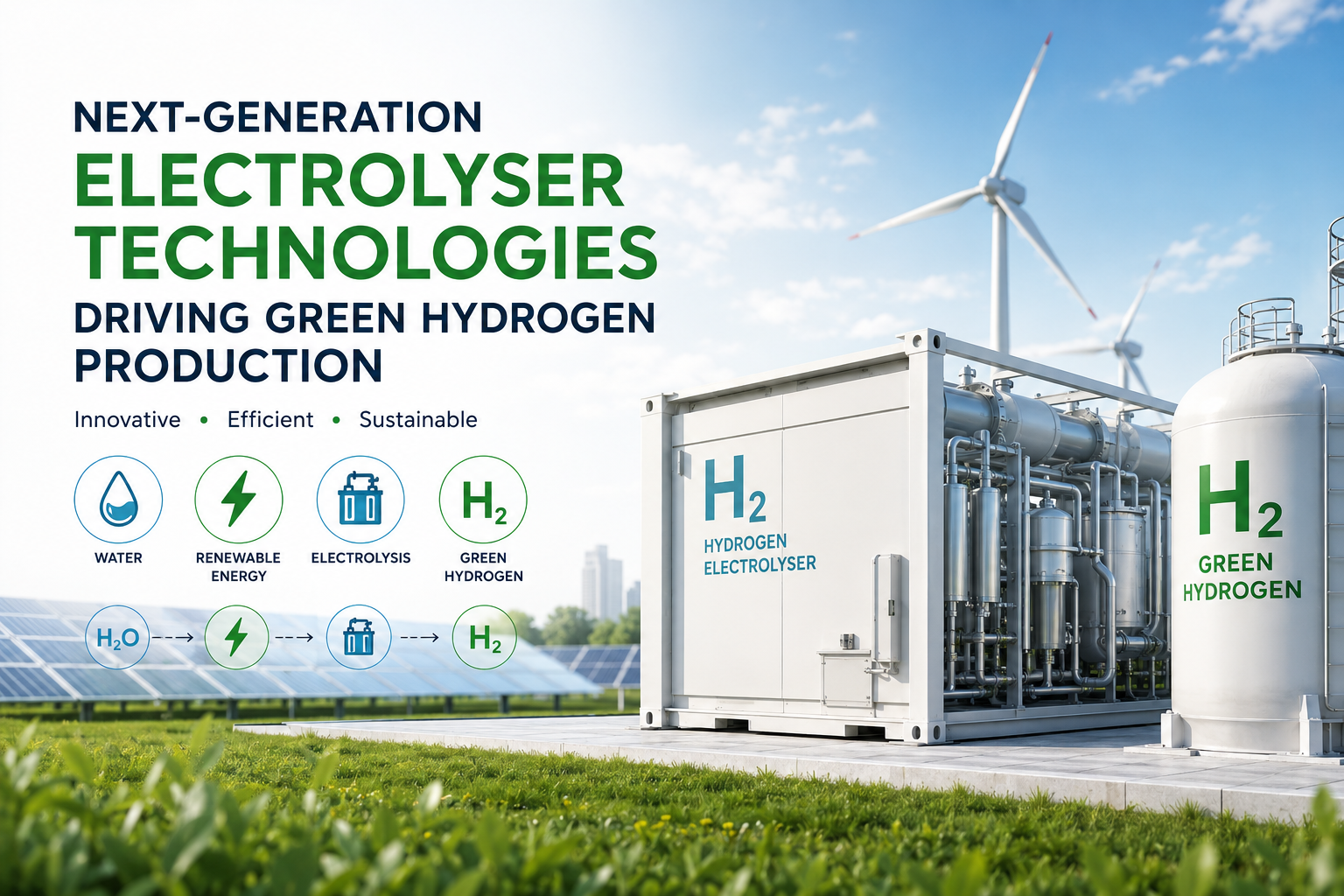
The growth of green hydrogen depends heavily on the development of next-generation electrolyser technologies. These systems use electricity to split water into hydrogen and oxygen, while newer designs aim to improve efficiency, flexibility, durability, and long-term production costs.
As renewable energy capacity grows worldwide, industries are looking for more efficient ways to produce low-carbon hydrogen. From steel and chemicals to transport and energy storage, advanced hydrogen electrolysers are becoming an important part of the transition towards cleaner industrial systems.
The main technologies currently shaping the sector include alkaline, Proton Exchange Membrane, Anion Exchange Membrane, and Solid Oxide electrolysers. Each technology has different strengths, costs, operating conditions, and potential applications.
This guide explains how these technologies work, how they compare, and why continued hydrogen technology innovation could play an important role in scaling green hydrogen production.
Key Takeaways
- Next-generation electrolyser technologies are essential for scaling green hydrogen production.
- Alkaline and PEM electrolysers are among the most commercially established technologies.
- AEM and SOEC technologies offer promising opportunities for future efficiency improvements.
- The best electrolyser depends on electricity availability, project scale, hydrogen demand, and end use.
- Smart controls, improved materials, and modular systems are driving hydrogen technology innovation.
- Electricity costs and equipment efficiency remain major factors affecting the cost of green hydrogen.
What Is an Electrolyser?
An electrolyser is a device that uses electricity to split water into hydrogen and oxygen through a process called electrolysis. When the electricity comes from renewable sources such as solar or wind, the hydrogen produced can be classified as green hydrogen.
The basic process is straightforward:
Water + Electricity → Hydrogen + Oxygen
However, producing green hydrogen at a competitive cost requires more than simply connecting an electrolyser to a power source. The efficiency of the equipment, the cost of electricity, operating conditions, water quality, and overall system design can all affect project performance.
For a complete explanation of the process, you can internally link green hydrogen production to your article:
How Green Hydrogen Production Works: A Step-by-Step Guide
Why Next-Generation Electrolyser Technologies Matter for Green Hydrogen
Every green hydrogen project depends on its ability to convert electricity into hydrogen efficiently.
While renewable electricity receives significant attention, the electrolyser determines how effectively that electricity can be used to produce hydrogen.
Modern electrolyser systems are being developed to:
- Improve hydrogen production efficiency
- Reduce electricity consumption
- Support flexible operation
- Integrate with solar and wind power
- Improve equipment durability
- Reduce maintenance requirements
- Lower long-term production costs
- Support larger industrial-scale projects
One important consideration for project developers is that the highest-efficiency system is not automatically the best choice for every project.
A system designed for stable, continuous operation may perform differently from one connected to highly variable wind or solar generation. This is why selecting the right electrolyser technology requires an understanding of both the equipment and the wider energy system.
What Makes Next-Generation Electrolyser Technologies Different?
Electrolysis itself is not a new concept. Alkaline electrolysers have been used for decades. What is changing is the scale, flexibility, efficiency, and intelligence of modern systems.
Today’s next-generation electrolyser technologies are being developed to address some of the biggest challenges facing green hydrogen production.
These include:
- High equipment costs
- Expensive renewable electricity
- Variable power supply
- Limited availability of critical materials
- Equipment degradation
- Large-scale manufacturing requirements
Modern advanced hydrogen electrolysers increasingly use improved membranes, catalysts, digital monitoring systems, modular designs, and advanced control technologies.
The industry is also working to reduce the use of scarce materials such as iridium and platinum while improving system durability and manufacturing capacity.
These developments are helping move green hydrogen from smaller pilot projects towards larger commercial and industrial applications.
Types of Next-Generation Electrolyser Technologies
Several electrolyser technologies are available today. Each one uses a different method to produce hydrogen and is suited to different operating conditions.
The four main technologies are:
- Alkaline Water Electrolysers
- Proton Exchange Membrane Electrolysers
- Anion Exchange Membrane Electrolysers
- Solid Oxide Electrolyser Cells
Alkaline Water Electrolysers
Alkaline Water Electrolysers, often called AWE, are among the oldest and most commercially established hydrogen production technologies.
They use a liquid alkaline electrolyte to help separate water into hydrogen and oxygen.
Advantages of Alkaline Electrolysers
- Proven technology
- Long operating history
- Suitable for large-scale projects
- Competitive equipment costs
- Good option for continuous hydrogen production
Limitations
- Can have a slower response to rapidly changing power input
- Generally have a larger physical footprint
- May be less suitable for some highly variable renewable energy applications
Best Applications
Alkaline electrolysers are often suitable for:
- Large hydrogen production facilities
- Industrial hydrogen plants
- Projects with stable electricity supply
- Continuous or near-continuous operation
For large-scale projects where cost and technology maturity are major priorities, alkaline electrolysers remain an important option.
Proton Exchange Membrane Electrolysers
Proton Exchange Membrane, or PEM, electrolysers use a solid polymer membrane instead of a liquid electrolyte.
They have become increasingly important in green hydrogen projects because of their flexibility and ability to respond quickly to changes in electricity supply.
Advantages of PEM Electrolysers
- Fast start-up and shutdown
- High hydrogen purity
- Compact system design
- Good integration with renewable electricity
- Strong performance under changing power conditions
Limitations
- Higher equipment costs
- Dependence on materials such as platinum and iridium
- Supply-chain challenges for some critical materials
Best Applications
PEM electrolysers can be well suited for:
- Solar-powered hydrogen production
- Wind-powered projects
- Hydrogen refuelling applications
- Distributed hydrogen production
- Projects with variable renewable electricity
Their ability to operate flexibly makes PEM technology particularly useful where electricity generation changes throughout the day.
Anion Exchange Membrane Electrolysers
Anion Exchange Membrane, or AEM, electrolysers are an emerging technology that aims to combine some advantages of alkaline and PEM systems.
AEM technology is attracting attention because it has the potential to reduce dependence on expensive precious metals while maintaining a compact and flexible system design.
Advantages of AEM Electrolysers
- Potential for lower-cost materials
- Reduced dependence on precious metals
- Compact design
- Good operational flexibility
- Potential for scalable hydrogen production
Current Challenges
- Earlier stage of commercial development
- Long-term durability is still being improved
- Large-scale deployment is more limited than alkaline and PEM
Best Applications
AEM electrolysers could become increasingly important for:
- Distributed hydrogen production
- Emerging hydrogen projects
- Modular systems
- Applications focused on reducing material costs
AEM represents one of the most interesting areas of hydrogen technology innovation, particularly if improvements in durability and large-scale manufacturing continue.
Solid Oxide Electrolyser Cells
Solid Oxide Electrolyser Cells, or SOEC systems, operate at significantly higher temperatures than alkaline, PEM, or AEM technologies.
These systems can use both electricity and heat to produce hydrogen.
This creates an important opportunity for industrial facilities that already generate high-temperature waste heat.
Advantages of SOEC Technology
- High potential efficiency
- Ability to use industrial heat
- Reduced electricity demand in suitable applications
- Strong potential for industrial integration
Limitations
- High operating temperatures
- Material and durability challenges
- More complex system design
- Still developing for wider commercial deployment
Best Applications
SOEC technology may be particularly useful for:
- Industrial facilities with available waste heat
- Chemical production
- Steel and manufacturing applications
- Integrated industrial energy systems
For industries exploring deep decarbonisation, SOEC could become an important technology where suitable heat sources are available.
You can internally link decarbonising heavy industry to:
The Role of Green Hydrogen in Decarbonizing Heavy Industry
Comparison of Next-Generation Electrolyser Technologies
| Technology | Relative Cost | Efficiency Potential | Flexibility | Best Application | Commercial Maturity |
|---|---|---|---|---|---|
| Alkaline | Lower | High | Moderate | Large-scale continuous production | Mature |
| PEM | Higher | High | Excellent | Variable renewable energy | Mature |
| AEM | Developing | High potential | High | Emerging and modular applications | Emerging |
| SOEC | Higher | Very high potential | Moderate | Industrial heat integration | Developing |
The comparison shows why there is no single electrolyser technology that is best for every project.
The right choice depends on several factors, including electricity availability, operating hours, project scale, hydrogen demand, budget, and industrial application.
Which Electrolyser Technology Should You Choose?
Choosing an electrolyser should begin with the project’s specific requirements rather than simply selecting the newest technology.
Choose Alkaline Electrolysers When:
- Large-scale hydrogen production is required
- Electricity supply is relatively stable
- Cost is a major priority
- Proven technology is preferred
Choose PEM Electrolysers When:
- Renewable electricity is highly variable
- Fast response is important
- High-purity hydrogen is required
- Space is limited
Consider AEM Electrolysers When:
- You are evaluating emerging technologies
- Reducing the use of precious metals is important
- A flexible and modular system is required
- The project can accommodate developing technology
Consider SOEC Technology When:
- High-temperature industrial heat is available
- Maximum efficiency is a major objective
- The project is integrated with an industrial process
The technology decision should be based on technical and economic analysis rather than efficiency ratings alone.
How Hydrogen Technology Innovation Is Changing the Industry
The future of green hydrogen is not only about installing more electrolysers. It is also about making them smarter, more efficient, easier to operate, and simpler to scale.
Modern hydrogen technology innovation is focused on improving several areas:
- Smart electrolyser control
- Digital monitoring
- Predictive maintenance
- Advanced catalyst materials
- Modular equipment
- Manufacturing automation
- Improved renewable energy integration
These developments could help improve project performance and reduce long-term production costs.
Smarter Electrolyser Control Systems
Solar and wind energy do not produce electricity at a constant level.
Solar output changes throughout the day, while wind generation can vary depending on weather conditions.
Modern control systems can help electrolysers respond to these changes more effectively.
Smart systems can support operators by helping them:
- Adjust hydrogen production based on electricity availability
- Monitor energy consumption
- Identify performance losses
- Improve operating efficiency
- Detect potential equipment problems
- Reduce unnecessary downtime
This flexibility is particularly important for projects that depend heavily on renewable electricity.
Digital Twins and Predictive Maintenance
Digital technology is becoming increasingly important in industrial energy systems.
A digital twin is a virtual model of a physical system that can be used to simulate performance under different conditions.
For electrolysers, this may help operators analyse:
- Changes in electricity supply
- Operating temperatures
- Pressure levels
- Hydrogen output
- Energy consumption
- Equipment degradation
Predictive maintenance can also help identify potential issues before a major equipment failure occurs.
For large hydrogen facilities, reducing unexpected downtime can improve reliability and help protect project economics.
Reducing the Use of Critical Materials
Some advanced electrolyser technologies depend on expensive and limited materials.
PEM systems, for example, can use precious metals such as platinum and iridium.
As the global electrolyser market expands, reducing dependence on these materials may become increasingly important.
Manufacturers and researchers are exploring:
- Lower catalyst loading
- Alternative catalyst materials
- Improved catalyst efficiency
- Longer component life
- Material recycling and recovery
Reducing material requirements could make advanced hydrogen electrolysers easier and more affordable to scale.
Modular and Scalable Electrolyser Systems
One of the major challenges for hydrogen projects is the high upfront investment required for large facilities.
Modular electrolyser systems can provide a more flexible development model.
Instead of building the entire hydrogen production capacity at once, a project may expand in stages.
A phased approach could involve:
- Starting with a pilot or smaller commercial project.
- Testing equipment performance.
- Securing additional renewable electricity.
- Developing customer demand.
- Expanding production capacity with additional modules.
Planning for future expansion from the beginning can make it easier to scale infrastructure later.
Benefits of Advanced Hydrogen Electrolysers
Next-generation systems are designed to improve both technical performance and long-term project economics.
Higher Energy Efficiency
Improved efficiency can reduce the amount of electricity needed to produce hydrogen.
Since electricity is one of the largest operating costs in green hydrogen production, efficiency improvements can have a significant impact on project economics.
Better Renewable Energy Integration
Flexible systems can operate more effectively with:
- Solar energy
- Wind energy
- Hybrid renewable systems
- Renewable electricity grids
This can help projects make better use of available clean electricity.
Increased Industrial Hydrogen Production
Larger and more advanced systems can support industries such as:
- Steel
- Chemicals
- Fertilisers
- Refining
- Green ammonia
- Shipping
- Heavy transportation
This is particularly important for sectors where direct electrification is difficult.
Lower Long-Term Operating Costs
The cheapest electrolyser is not always the lowest-cost option over its entire operating life.
Businesses should consider:
- Equipment costs
- Electricity consumption
- Maintenance requirements
- Replacement components
- Equipment lifespan
- Hydrogen output
Evaluating the total cost of ownership can provide a more realistic understanding of long-term project economics.
Easier Scalability
Modular systems can allow companies to increase production as hydrogen demand grows.
This can support a gradual development path:
Pilot Project → Commercial Facility → Large-Scale Hydrogen Production
Challenges Still Facing Electrolyser Technology
Despite rapid development, several challenges remain.
High Capital Costs
An electrolyser is only one part of a complete hydrogen production facility.
Projects may also require:
- Renewable electricity infrastructure
- Water treatment
- Hydrogen purification
- Compression systems
- Storage
- Transport infrastructure
The cost of the complete hydrogen value chain remains an important challenge.
Renewable Electricity Costs
The cost of electricity has a major influence on green hydrogen production costs.
Even a highly efficient electrolyser can produce expensive hydrogen if electricity prices are high.
Successful projects often consider:
- Solar resources
- Wind resources
- Grid access
- Electricity prices
- Seasonal generation patterns
- Proximity to hydrogen customers
Water Availability and Treatment
Electrolysers require water, and large projects must consider water availability and quality.
Depending on the project, water may require treatment before it can be used in the hydrogen production process.
Developers should evaluate:
- Water availability
- Water quality
- Treatment requirements
- Environmental impact
- Long-term supply security
Equipment Durability
Electrolysers operate under demanding conditions.
Important components can degrade over time, particularly when systems experience:
- Frequent start and stop cycles
- Variable electricity input
- High temperatures
- High operating pressure
Improving durability remains an important area of electrolyser research and development.
Practical Recommendations for Businesses Investing in Electrolyser Technology
Selecting the right electrolyser requires more than comparing equipment specifications.
Start With the End Use of Hydrogen
Clearly define how the hydrogen will be used.
For example:
- Continuous industrial production may require different equipment from a renewable energy project.
- Hydrogen refuelling may require rapid response and high purity.
- Industrial facilities with waste heat may benefit from high-temperature electrolysis.
The final use of hydrogen should influence technology selection.
Evaluate Renewable Energy Availability
Before selecting a system, analyse:
- Solar potential
- Wind resources
- Grid access
- Electricity prices
- Seasonal changes
- Energy storage requirements
The local energy profile can significantly affect which technology is most suitable.
Plan for Future Expansion
Consider whether the system can grow with future demand.
Important questions include:
- Is additional land available?
- Can electrical infrastructure be expanded?
- Is sufficient water available?
- Can additional storage be added?
- Can new electrolyser modules be installed?
Look Beyond Initial Equipment Cost
Consider the complete lifecycle of the system.
Ask:
- How much electricity will it consume?
- What maintenance is required?
- How long will critical components last?
- What is the expected hydrogen output?
- How easily can capacity be expanded?
Consider the Complete Hydrogen Value Chain
Hydrogen production is only the first stage.
A successful project may also require:
- Compression
- Storage
- Pipelines
- Transportation
- Distribution
- End-user infrastructure
Project planning should consider the complete hydrogen ecosystem.
Expert Perspective
Selecting an electrolyser is not simply about choosing the technology with the highest efficiency rating.
In practical projects, renewable electricity availability, operating hours, hydrogen demand, water quality, infrastructure, maintenance requirements, technology maturity, and total lifecycle costs can all influence the final decision.
A PEM system may be highly suitable for one renewable energy project, while an alkaline system may offer better economics for another. The most effective approach is to match the electrolyser technology with the energy source and the final hydrogen application.
The Future of Electrolyser Technology and Green Hydrogen Production
The future of green hydrogen will depend heavily on continued progress in electrolyser technology.
Several developments are likely to shape the next phase of the industry:
- Larger electrolyser manufacturing facilities
- Lower equipment costs through scale
- Improved catalyst materials
- Reduced dependence on critical minerals
- AI-based monitoring
- Digital twins
- Predictive maintenance
- Better renewable energy integration
- Modular industrial-scale systems
The future is unlikely to be dominated by a single technology.
Instead, alkaline, PEM, AEM, and SOEC systems are likely to serve different applications.
Alkaline systems may remain important for large projects with stable electricity.
PEM technology may continue to play a major role in flexible renewable energy projects.
AEM systems could become more important as durability and commercial scalability improve.
SOEC technology may offer strong opportunities in industrial facilities with access to high-temperature heat.
The most successful hydrogen projects will likely be those that match the right technology with the right energy source, location, infrastructure, and end use.
Frequently Asked Questions
What are next-generation electrolyser technologies?
Next-generation electrolyser technologies are advanced systems designed to produce hydrogen from water more efficiently, flexibly, and at lower long-term costs. The main technologies include alkaline, PEM, AEM, and SOEC electrolysers.
What is the difference between PEM and alkaline electrolysers?
Alkaline electrolysers are a mature technology that is often suitable for large-scale and stable operations. PEM electrolysers are more flexible and can respond quickly to changes in renewable electricity supply, but they generally have higher equipment costs.
Are AEM electrolysers commercially available?
AEM electrolysers are moving towards wider commercial deployment, but they are less mature than alkaline and PEM technologies. Long-term durability and large-scale manufacturing remain important areas of development.
Why are SOEC electrolysers considered highly efficient?
SOEC systems operate at high temperatures and can use heat in addition to electricity. In industrial applications with available waste heat, this can reduce electricity requirements and improve overall efficiency.
Which electrolyser is best for renewable energy projects?
PEM electrolysers are often well suited to highly variable renewable electricity because they can respond quickly to changes in power supply. However, the best technology depends on the specific project, scale, and energy profile.
Can next-generation electrolysers reduce green hydrogen costs?
Improvements in efficiency, manufacturing scale, advanced materials, automation, and equipment durability can help reduce green hydrogen production costs. The price of renewable electricity will remain a major factor.
What should businesses consider before investing in an electrolyser?
Businesses should evaluate hydrogen demand, electricity availability, project location, water supply, infrastructure, technology maturity, maintenance requirements, and future expansion plans.
Conclusion
Next-generation electrolyser technologies will play a major role in making green hydrogen production more efficient, flexible, and scalable.
Alkaline and PEM systems are already commercially established, while emerging technologies such as AEM and SOEC could create new opportunities for reducing costs, improving efficiency, and supporting specialised industrial applications.
The best technology is not always the newest or the most efficient on paper. The right choice depends on renewable electricity availability, hydrogen demand, project scale, operating conditions, infrastructure, and long-term business goals.
As hydrogen technology innovation continues to improve materials, digital monitoring, manufacturing capacity, and system performance, advanced hydrogen electrolysers are expected to become increasingly important in the transition towards cleaner energy and lower-carbon industry.
To explore the wider role of hydrogen in the energy transition, link naturally to:
- What Is Green Hydrogen? A Simple Explainer
- How Green Hydrogen Production Works: A Step-by-Step Guide
- Green Hydrogen vs Blue and Grey Hydrogen: What You Need to Know
- The Role of Green Hydrogen in Decarbonizing Heavy Industry
To understand how these technologies are becoming smarter and more efficient, read How Hydrogen Technology Innovation Is Changing the Industry.