
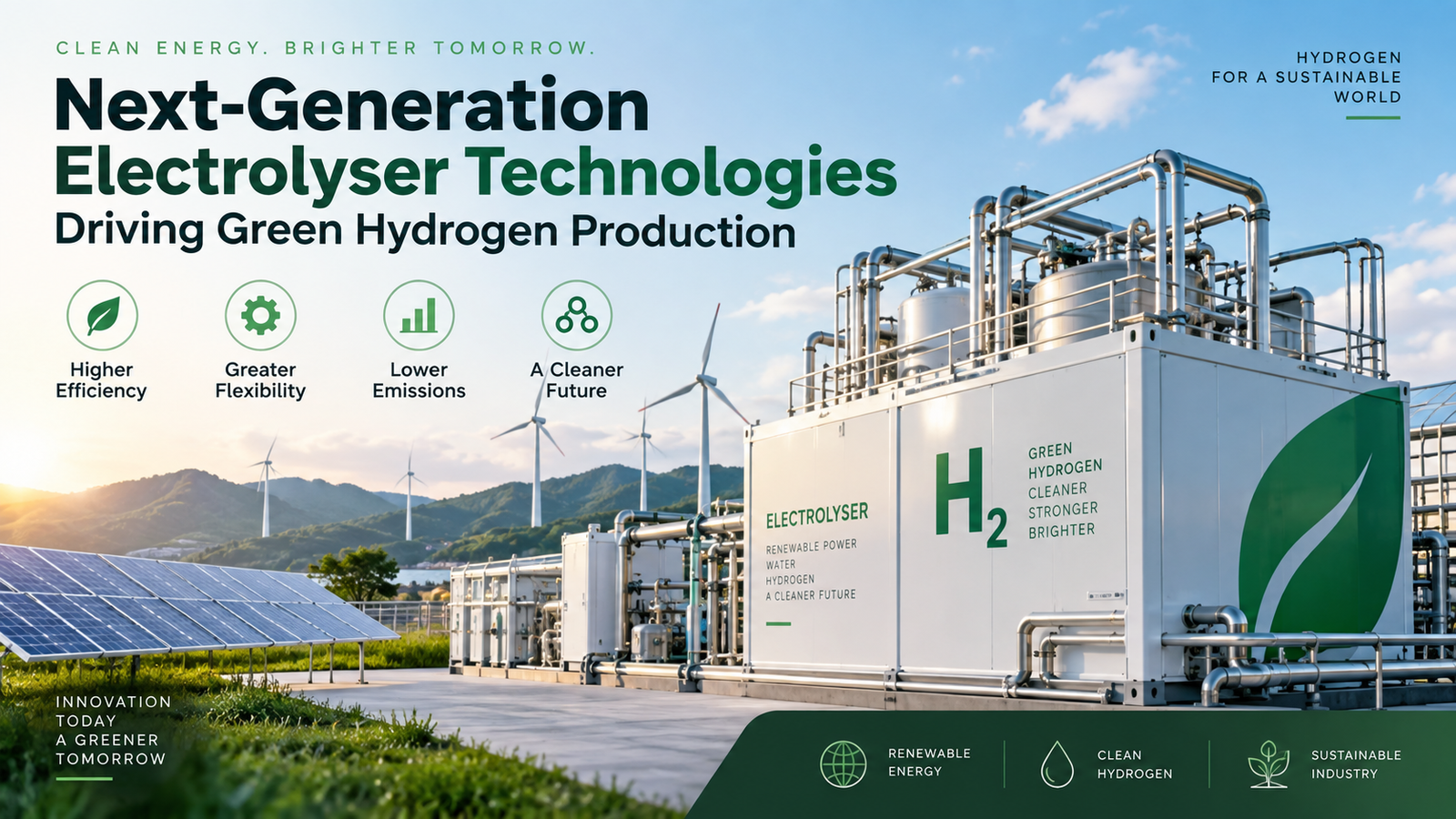
Advanced hydrogen electrolysers are becoming a key technology for scaling green hydrogen production. As renewable electricity becomes more widely available, hydrogen developers are looking for electrolysers that can operate efficiently, respond to changing power supply and support large-scale production.
Electrolyser technology has developed significantly over recent years. Alkaline and PEM systems are already commercially established, while technologies such as anion exchange membrane and solid oxide electrolysis are attracting growing attention.
However, there is no single electrolyser that is best for every project.
The right choice depends on factors such as renewable electricity availability, operating hours, hydrogen demand, water supply, site conditions, project scale and long-term economics.
This guide explains the main electrolyser technologies, where they fit, and what businesses should consider when evaluating the next generation of hydrogen production systems.
What Are Advanced Hydrogen Electrolysers?
Advanced hydrogen electrolysers are improved or emerging electrolysis systems designed to produce hydrogen with greater efficiency, flexibility, durability, scalability or cost competitiveness.
They build on established electrolysis technologies while introducing improvements in areas such as:
- Electrolyser efficiency
- Operating flexibility
- Materials and catalysts
- System durability
- Renewable energy integration
- Automation and monitoring
- Modular design
- Manufacturing efficiency
- Heat integration
The goal is not simply to produce more hydrogen. The goal is to produce hydrogen efficiently and reliably within the conditions of a real industrial or energy project.
Why Electrolyser Technology Matters for Green Hydrogen
Green hydrogen is produced by splitting water into hydrogen and oxygen using electricity.
When renewable electricity is used, the process can provide a low-carbon pathway for hydrogen production. However, electricity consumption represents a major part of the production process.
This makes electrolyser performance particularly important.
The electrolyser can influence:
- Electricity consumption
- Hydrogen production cost
- Production capacity
- Operating flexibility
- Equipment requirements
- Maintenance requirements
- Overall project economics
For this reason, choosing an electrolyser should be treated as a complete project decision rather than simply an equipment purchase.
A system that looks attractive based on its purchase price may not necessarily provide the lowest overall hydrogen production cost once electricity, utilisation, maintenance, storage and other infrastructure are considered.
Main Electrolyser Technologies
Several electrolyser technologies are being developed and deployed today. Each has different characteristics and potential applications.
Alkaline Electrolysers
Alkaline electrolysis is one of the most established approaches to hydrogen production.
The technology uses an alkaline electrolyte to enable the movement of hydroxide ions during the electrochemical process.
Alkaline electrolysers have a long commercial history and are already used in industrial hydrogen production.
Advantages of alkaline electrolysers
- Established technology
- Long operating history
- Commercial availability
- Suitable for large-scale applications
- Mature supply chains
- Potentially lower reliance on some expensive catalyst materials
Limitations
Traditional alkaline systems can have limitations when very rapid changes in production are required. However, modern designs continue to improve operational flexibility.
For projects with relatively stable electricity supply and large hydrogen production requirements, alkaline technology can remain a practical option.
PEM Electrolysers
PEM stands for Proton Exchange Membrane.
PEM electrolysers use a solid polymer membrane instead of a liquid alkaline electrolyte.
One of their main advantages is their ability to respond relatively quickly to changes in electricity input. This makes PEM technology particularly interesting for projects integrating variable renewable energy.
Advantages of PEM electrolysers
- High operating flexibility
- Compact system design
- Fast response to changing power
- Good compatibility with variable renewable electricity
- Commercially available technology
Challenges
PEM systems can involve higher costs than some alkaline systems. They also commonly rely on platinum-group materials, including iridium, which creates an important area for ongoing technology development.
Reducing critical-material requirements while maintaining performance is therefore an important part of hydrogen technology innovation.
Anion Exchange Membrane Electrolysers
Anion Exchange Membrane, or AEM, electrolysis is an emerging technology.
AEM systems use an anion exchange membrane to transport hydroxide ions.
The technology is attracting interest because it aims to combine some characteristics of alkaline electrolysis with the compact design and operating characteristics associated with membrane-based systems.
Potential benefits
- Potentially lower use of expensive catalyst materials
- Compact system design
- Potential for flexible operation
- Opportunity for future cost reduction
Current challenges
AEM technology is less mature than established alkaline and PEM systems.
Important development areas include:
- Membrane durability
- Catalyst performance
- Long-term stability
- Scale-up
- Manufacturing
AEM could become increasingly important as these challenges are addressed and commercial deployment expands.
Solid Oxide Electrolysers
Solid oxide electrolysis cells, commonly known as SOECs, operate at high temperatures.
Unlike low-temperature electrolysis systems, SOEC technology can use both electricity and heat in the hydrogen production process.
This creates an interesting opportunity for industrial facilities where suitable heat sources are already available.
Potential advantages
- High efficiency under suitable operating conditions
- Potential integration with industrial heat
- Useful for certain industrial applications
- Potential to reduce electricity requirements when heat is available
Challenges
SOEC systems operate at high temperatures, which creates additional engineering and operational requirements.
They are therefore particularly interesting for projects where appropriate industrial heat integration is possible.
Advanced Hydrogen Electrolysers and Renewable Energy
One of the most important areas of development is the integration of advanced hydrogen electrolysers with renewable energy.
Solar and wind generation are variable. Solar output changes during the day, while wind generation can change depending on weather conditions.
Electrolysers therefore need to operate within the characteristics of the available electricity supply.
A typical system may look like:
Renewable Energy → Power Management → Electrolyser → Hydrogen Processing → Compression/Storage → End User
The exact configuration depends on the project.
For example, a hydrogen project using dedicated solar generation may have a different operating profile from a project connected to a combination of wind, solar and grid electricity.
This is why developers should assess the complete energy profile before selecting an electrolyser.
What Is Driving Hydrogen Technology Innovation?
The next generation of electrolyser development is focused on several important areas.
1. Higher Efficiency
Reducing electricity consumption per kilogram of hydrogen can improve project economics.
Even relatively small efficiency improvements can become significant when equipment operates for thousands of hours.
2. Lower Material Requirements
Some electrolyser technologies depend on expensive or strategically important materials.
Researchers and manufacturers are working to reduce material intensity and identify alternatives without compromising performance.
3. Better Durability
Electrolyser degradation can affect long-term project performance.
Improving component life can help reduce replacement requirements and support more predictable operation.
4. Greater Flexibility
As renewable electricity becomes a larger part of energy systems, electrolysers may increasingly need to operate under changing power conditions.
This makes dynamic operation an important area of innovation.
5. Improved Manufacturing
Scaling electrolyser manufacturing can potentially reduce equipment costs and improve supply-chain efficiency.
Large-scale manufacturing may also support more standardised and modular systems.
6. Smarter Monitoring
Sensors, automation and advanced control systems can provide better information about plant performance.
Operators can monitor:
- Hydrogen output
- Electricity consumption
- Temperature
- Pressure
- System efficiency
- Equipment condition
- Maintenance requirements
Better monitoring can support more informed operational and maintenance decisions.
Advanced Electrolyser Technology Comparison
There is no universal winner among electrolyser technologies.
The right solution depends on project requirements.
| Technology | Development Status | Key Strength | Main Consideration |
|---|---|---|---|
| Alkaline | Commercial | Proven and established | Dynamic operation |
| PEM | Commercial | Flexible operation | Critical materials and cost |
| AEM | Emerging | Potential material advantages | Durability and scale-up |
| SOEC | Emerging/commercialising | High-temperature efficiency | Heat integration |
This comparison should be viewed as a starting point rather than a technology ranking.
How to Choose the Right Electrolyser
Businesses planning green hydrogen production should evaluate the complete project before selecting technology.
1. Understand Hydrogen Demand
Start by defining:
- Required hydrogen volume
- Production schedule
- Hydrogen purity
- End-use requirements
- Expected future demand
2. Assess Electricity Supply
Consider:
- Solar availability
- Wind availability
- Grid connection
- Electricity cost
- Renewable variability
- Expected operating hours
3. Evaluate Water Availability
Water availability and treatment requirements can influence both project design and operating costs.
4. Consider Site Conditions
Site access, land availability, infrastructure and proximity to hydrogen users can all affect the overall project.
5. Compare Total Project Economics
Do not evaluate electrolysers only on their purchase price.
Consider:
- Capital expenditure
- Electricity consumption
- Maintenance
- Replacement requirements
- Operating hours
- Storage
- Compression
- Infrastructure
- Financing
6. Plan for Future Expansion
If hydrogen demand is expected to increase, the initial project design should consider future expansion.
Modular development can provide a practical way to increase production capacity over time.
Why the Cheapest Electrolyser May Not Be the Best Choice
A common mistake in early hydrogen project planning is focusing too heavily on the initial equipment cost.
The cheapest electrolyser on paper may not deliver the lowest overall hydrogen cost.
For example, a project with highly variable renewable electricity may place greater value on operational flexibility.
Another project with access to industrial waste heat may benefit from considering high-temperature electrolysis.
Similarly, a large project with relatively stable power availability may find an established alkaline solution more appropriate.
The better approach is to evaluate the total cost of ownership and complete operating environment.
The Future of Advanced Hydrogen Electrolysers
The future of electrolyser technology is likely to involve several technologies rather than one dominant solution.
Alkaline and PEM systems are expected to remain important as commercial deployment expands. At the same time, AEM, SOEC and other emerging approaches could create additional options for specific applications.
Future development is likely to focus on:
- Higher efficiency
- Lower electricity consumption
- Longer equipment life
- Reduced critical-material requirements
- Flexible renewable operation
- Larger production systems
- Modular manufacturing
- Better automation
- Improved system integration
The International Energy Agency reported that global installed electrolysis capacity exceeded 4 GW in 2025, demonstrating the rapid expansion of electrolysis deployment. However, the agency also highlights continuing challenges around project development, investment and hydrogen demand.
This means technology development alone will not determine the success of green hydrogen.
Projects will also need reliable renewable electricity, suitable infrastructure, credible hydrogen demand and commercially viable business models.
Practical Advice for Businesses Planning a Hydrogen Project
If your organisation is evaluating green hydrogen production, avoid starting with the question:
“Which electrolyser should we buy?”
Instead, start with:
“What does our project require?”
A practical evaluation should follow this sequence:
- Identify the hydrogen application.
- Estimate current and future hydrogen demand.
- Assess renewable electricity availability.
- Evaluate water and site conditions.
- Compare suitable electrolyser technologies.
- Assess storage and hydrogen delivery requirements.
- Calculate the complete project economics.
- Consider future expansion.
- Evaluate operational and maintenance requirements.
- Select technology based on the complete project profile.
This approach can help reduce the risk of choosing technology that looks attractive initially but does not fit the project’s long-term operating requirements.
Key Takeaways
Advanced hydrogen electrolysers are an important part of scaling green hydrogen production, but the best technology depends on the project.
The key points are:
- Alkaline electrolysers are commercially established.
- PEM electrolysers provide strong operational flexibility.
- AEM technology offers potential improvements in materials and system design.
- SOEC technology can be attractive where industrial heat is available.
- Electricity consumption has a major influence on hydrogen economics.
- Renewable energy integration should be considered during technology selection.
- Equipment durability and material requirements remain important development areas.
- The lowest electrolyser purchase price does not necessarily mean the lowest hydrogen cost.
- Businesses should evaluate the complete hydrogen production system before selecting technology.
Frequently Asked Questions
What are advanced hydrogen electrolysers?
Advanced hydrogen electrolysers are improved or emerging electrolysis systems designed to increase efficiency, flexibility, durability, scalability or cost competitiveness in hydrogen production.
Which electrolyser technology is best for green hydrogen production?
There is no single best technology. Alkaline and PEM are commercially established, while AEM and SOEC provide emerging alternatives for specific applications. The best choice depends on electricity supply, operating profile, scale, hydrogen demand and project economics.
What is the difference between alkaline and PEM electrolysers?
Alkaline electrolysers use an alkaline electrolyte and have a long commercial history. PEM electrolysers use a polymer membrane and generally offer greater flexibility when responding to changing electricity supply.
Why are AEM electrolysers receiving attention?
AEM technology has the potential to combine membrane-based system characteristics with alkaline chemistry while reducing reliance on some expensive catalyst materials. However, durability and commercial scale-up remain important challenges.
When can SOEC technology be useful?
SOEC can be particularly interesting for industrial projects where suitable high-temperature heat is available because the technology can use heat as part of the electrolysis process.
Can electrolysers operate with solar and wind power?
Yes. Electrolysers can be integrated with renewable electricity systems. However, the technology and operating strategy should match the variability and availability of the renewable power source.
What factors affect the cost of green hydrogen?
Important factors include renewable electricity costs, electrolyser capital cost, utilisation, efficiency, financing, water treatment, compression, storage, transport and overall project infrastructure.
Conclusion
Advanced hydrogen electrolysers will play an important role in the expansion of green hydrogen production. Established alkaline and PEM technologies already provide commercial pathways, while AEM and SOEC systems are creating additional opportunities for future projects.
The most important development, however, is not simply creating a more advanced electrolyser. It is creating a system that works efficiently with renewable energy, infrastructure, hydrogen demand and industrial requirements.
This is where hydrogen technology innovation becomes particularly important.
For businesses considering a green hydrogen project, technology selection should begin with the project’s requirements. Electricity supply, hydrogen demand, water availability, operating hours, infrastructure, storage and long-term economics should all be considered before selecting an electrolyser.
Green Hydrogen Global can help businesses understand the wider considerations involved in developing hydrogen projects, from early feasibility assessment and engineering to production, infrastructure and commercial planning.
Ready to explore your hydrogen project opportunity? Start with a green hydrogen feasibility assessment and build the project around the right technical and commercial foundations.